In the 8th grade, "Life's Little Instruction Book" was required reading. our teachers felt learning secularized parables would be more beneficial for our intellectual growth
Rather than learn the art of well-crafted sentences through a standard curriculum of books like The Jungle Book, the English department of my sleepy suburban school handed out copies of Life’s Little Instruction Book and Chicken Soup for the Soul to my 8th grade class. The thought must have been that learning secularized parables would be more beneficial for our intellectual growth.
Eventually, we were charged with the assignment of creating our own Life’s Little Instruction Book. We knew nothing of the real world and yet we were going to act as authorities on “how to live a happy and rewarding life.”
I recently found my flamboyantly illustrated attempt and was amused. “Don’t worry if you’re not the prettiest rose. We’re all beautiful in our own light” — my teacher found this little stroke of transcendental wisdom endearing. If I had to rewrite my 8th grade book of advice today, I might include that same instruction, though perhaps rewritten with less sentimentality, and add a few other insights I’ve picked up in the 13 years I’ve traveled since…
Invest in at least 1 Ina Garten cookbook. The orange scones in this one are an ace.
1. Invest in at least one Ina Garten cookbook
2. (Re)read Strunk & White’s “The Elements of Style”
Every year, I I try not to blame Hallmark for the excessive quantities of pink hearts floating around retail stores come February. I try not to label St. Valentine’s Day a holiday institutionalized by older married women in order to make younger single women feel inadequate. I try not to reduce February 14th to an excuse to eat excessive quantities of dark chocolate and caramel.
I "accidentally" knock Sweethearts off the shelf and "accidentally" step on them. I try not to, but I can't help it.
Most years I fail — I eat thousands of calories worth of heart-shaped truffles, I shoot bitter stares at older couples, and I “accidentally” knock bags of Sweethearts off the drug store shelf and “accidentally” step on them.
I blame Katie and a boy named Tony for my general animosity towards the holiday.
In the 6th grade, a single carnation-gram arrived on my homeroom desk with a note “Love, your secret admirer.” I was appropriately tickled pink. I moved from social studies to earth science on a cloud — what joy! At dismissal, Katie confessed she had bough carnation-grams for all our girl friends. My little 11 year old balloon was burst.
Many, many, many years later, Tony would burst yet another heart-shaped bubble.
When Tony suggested we spend Valentine's Day together, this is what I envisioned... not a bar on All You Can Eat Wings! night
Of all our friends, we were the only two still single, and I confess that I was somewhat “in love” with him. When he suggested that we spend Valentine’s Day together, I took it as a sign he wanted to be more than friends. We agreed on casual, but when we ended up in a sports bar on “All You Can Eat Wing Night,” I wished I had worn my sports bra instead of the lacy push-up restricting the blood supply to my extremities. Midway through the evening, my toes were numb and a chunk of some frat-boy’s wayward vomit landed on my pink satin motorcycle jacket.
As Tony walked me home, we conversed by screaming, our ears still not adjusted to normal noise levels. We stopped on the stoop of my building and moved close together, our eyes full of intention and confusion. I don’t know how much time passed, but I’m sure we reached a world record for longest awkward pause. I eventually broke the stand-off with a kiss on the cheek and a g’night.
My bra had broken a rib, my jacket reeked of regurgitated chicken wings, and my “date” and I had loss our sense of hearing — it was the most romantic Valentine’s Day I had ever had.
I’m sure one day I’ll be over my February the 14th phobia and once again become lover of Valentine’s Day. But I doubt carnations and men named Tony will have anything to do with my recovery.
All these critics agree -- The Social Network is a landmark film. Maybe I watched the wrong movie.
News Feed: “Facebook is now in a complicated relationship with The Social Network.”
I may be the last person on the planet who, before this weekend, had not seen “The Social Network.” Now that I’ve caught up, I wish I was still the last person on the planet who hadn’t seen “The Social Network.”
My opinion of the movie has little to do with the fact that I was friends with Mark Zuckerberg in public school. We weren’t extremely close, but I knew him well enough that my mother was willing to make him the sole exception to the “No Dating Until You’re 18” rule (oh! Mothers and their power of foresight!). “The Social Network” is not a bad movie because it’s an inaccurate portrayal of one of the most enigmatic (and powerful) characters of our generation. It’s a bad movie because it’s superficial, boring, and disjointed.
Our obsession with Facebook and its creator is a complicated one that dictates the way we respond to “The Social Network.” Until recently, Zuckerberg stayed out of the spotlight. When we did see him interviewed, he was reticent, brilliant but hard to relate to. The lawsuits attacking possible underhanded dealings threatened to take Facebook from us. We knew there were a few of them, but what were they about? And yet, while there were those who tried to halt its forward march, “to Facebook” became an action we can’t live without.
We’re inclined to like “The Social Network” because as Facebook rapidly penetrated every click and every interaction, we craved a neat summary of how this idea born in a Harvard dorm room transformed into a global phenomenon — a phenomenon that has irrevocably changed the way people connect.
In a world where getting their first determines "coolness," The Social Network is only cool because it told the facebook story first.
We live in a world where getting there first is the principal criteria for “coolness,” the leading criteria for critical acclaim. The iPod will always trump other mp3 players because it got there first. “The Social Network” will always trump future Facebook or Mark Zuckerberg movies because it was the first to tell us the Facebook story. Stephen Holden of the NYTimes calls it “a once-in-a-generation movie,” and it is, simply because the next Facebook movie is another decade in the making.
Facebook is an empowering platform that allows us to not only communicate, but to curate our lives. It enables us to pick and choose and update the details that shape the way we’re perceived by our peers. We have become objects in an online museum where our solo-exhibits change as frequently as we choose. Even if Facebook one day implodes, an unlikely event now that it’s so ingrained in our social and digital fabric, we will never revert to the old ways of locating, messaging, and digitally relating to people.
That’s the true Oscar-caliber performance of Mark Zuckerberg’s social network. Sorkin’s and Fincher’s snooze fest pales in comparison.
His name was Simone Volpini and we met on a blistering August night in Paris.
The penultimate city of romance - Paris - an Italian architect and the promise of letters exchanged. It was too good to be true
I was dining in an over-sized bistro sandwiched between the tall, blond, brown-eyed Italian Simone and a handsome gay couple who had spent the day at the Musee D’Orsay. The couple and I quickly dove into conversation after one of the men compared my full pink cheeks and white skin to a Renoir — it was the only time I felt compelled to like and discuss Renoir. After they paid their check and bid me bonsoir, Simone asked me if I was American.
Simone was from Rome and was the only son of an Italian architect. He drove a white Vespa and was studying to take over his father’s business. He spoke little French and equally minimal English. I read Latin but spoke no Italian. We giggled through a conversation of muddled pig-romance-languages while we sipped our coffee. He called me his American Beauty and walked me out into the street to help me find a taxi. As I slipped into the car, he handed me a piece of paper.
“You will write me. Your letters will teach me English. I will teach you Italian, and then you will come stay with me in Rome.” A kiss on the cheek and we were both off into the Paris night.
Back home in the states, I wrote Simone a letter. His handwriting was atypical for an architect — messy and non-linear — and I could barely decipher the address. His letter was returned to sender.
Alas, I would not get to play the part of Audrey Hepburn in Roman Holiday.
The sole letter I've received from a friend, celebrating our graduation from college 4 years ago. I still have it.
It had been years since I had thought about the love letter exchanges that never were, but then a chat with a guy I’d met early last week reminded me why I found the idea of a pen-pal romance so appealing.
“You’re working very hard to get me to go out with you,” I typed in the text box of gchat after having received a handful of flirty texts and emails over the course of the week.
“There’s nothing hard about sending you a text message or an email. I sent them on my way to lunch.”
Clearly, he wasn’t a smooth operator, but Chad had made a very good point: sending a one-line message while you’re working on other things is not very hard.
In the age of texting and sexting, we’ve come to expect constant and instantaneous messages of love (or lust). On the one hand, there’s something extremely romantic about receiving, at any time of the day, a note that lets you know your beloved is thinking of you. On the other, one wonders if this communication blitz doesn’t lack of bit of sincerity. If it’s so easy to key in an “I think I’m in love w u” when you’re on the go, then do you really mean it? Texts don’t necessarily demonstrate commitment… sometimes I wonder if they might even be a sign of over-commitment.
Writing letters are hard. They require time and thought. They lack that benefit of instant on-screen editing and spell-check — your flaws are more evident. And it seems that sitting down with pen and paper is something we only do these days when we’re taking notes, that is, if we haven’t forsaken a legal pad in the name of an ipad. It was not so long ago that a letter, composed with pen and ink, was our primary means of communicating from afar. We’re out of the habit of letter writing.
Call me old-fashioned but “Ever thine, ever mine, ever ours” reads so much better when it’s scrawled on paper.
I kept the letter I wrote to Simone and every time I travel to Rome, I stuff it in my backpack. It wasn’t a love letter, but just in case I run into a tall blond architect riding around the Coliseum on a white Vespa, I’d like him to know I didn’t take the easy way out.
I don’t know if you realize this, but Kathleen is a problematic name. It’s rarely on those iridescent magnets or “gold” nameplate necklaces you find at drugstores. There’s an overstock on Katherine and Catherine, but rarely a Kathleen. People aren’t used to the name and hearing it confuses them. It took Buckie 7 years to remember my name was not Kaitlin.
When I was 9, all of my friends were developing nicknames — Danielle was becoming a Dani, Jessica was turning into a Jess, and everyone wanted to call me Kathy. I know a grown-up Kathy who played golf, voted Republican, believed in creationism, and liked Florida. No, I couldn’t be a Kathy. My father thought it was cute to still call me Poo-Poo Head. No, that wouldn’t do either.
“Your name is Kathleen. If we had wanted to call you Kate or Katie or Kathy we would have named you Kate, Katie, or Kathy,” my parents said when I whined about not having a proper nickname. “Don’t ever let anyone call you Kathy.”
Apparently, my mother almost called me Ashley. If you knew me, you know I could never be an Ashley.
Am I Kat tonight or Kathleen?
It wasn’t until college that the need for a nickname would turn into a full-fledged identity crisis. On the first day of orientation I met Mike and we instantly became best friends. “Can I call you Kat?” he asked. “I like to have nicknames for all my girl friends.” Sure, why not! College, I decided, was a time for reinvention and so I likewise decided to accept Kat as my new identity.
But given “Kat’s” newness, I was awkward with introductions and never fully embraced the adopted persona. Soon, I found that all my teammates and athlete friends were the ones that called me Kat while everyone I met outside that community called me Kathleen. Kat became not my new incarnation, but an alter-ego. It was all very confusing.
By the time I finished grad school, Kat had faded to the name I gave at Starbucks when ordering my venti latte.
The truth is, my parents’ adamant rejection of a diminutive form of my name had instilled in me a general distaste for nicknames and pet names. Whenever a guy calls me “Honey,” I cringe inside, while a “Baby” makes me feel like a cheap teeny-bopper. Once upon a time, there was a guy I would meet for drinks that insisted on calling me Kitty. He didn’t last long. Though, maybe the biggest problem I have with being called Baby or Honey or Kitten or Pumpkin is not that its a pet name — it’s that it’s insincere and impersonal.
How many people in your life do you call Hon or Sweetie? I bet far more than the number you call Kathleen.
Of late, I’ve found a kindred spirit in Cinderella.
Sure, I have neither an evil step-mother who locks me in an attic nor ugly step-sisters who steal my clothes and spill pizza grease on them, but I have my share of chores that keep me looking like I just rolled around in a cinder bin.
Every Cinderella needs her own set of seamstress mice
Mornings are spent makeupless in old jeans and a t-shirt running errands for the family while my mother recovers from her recent hip replacement. I race through grocery stores, power-mop the kitchen floor, dust away the cobwebs from the corners of the living room, transfer the laundry from the hamper to the washing machines, groom the dogs, and put two meals on the table while prepping the third for my return at night. The projects I’m working on have me on call 24-7, and the majority of what I accomplish during the day is done between blackberry emails on the run and conference calls from my compact-SUV. At night, I’m “training” and if I’m lucky, home in my sweats by 10PM.
In short, I’m like every other modern woman as she tries to make her way in life on her own two feet while contributing to her family’s overall well-being. There isn’t much in the way of glamor, but there isn’t much to complain about.
On the console table near my front door sits an invitation to a charity ball. The event is being organized by a woman whose generosity, strength, and heart I greatly admire, and who has recently emerged as a fairy god-mother of sorts. A little bit of sparkle is something to look forward to, especially in the name of a good cause. As for the Cinderella transformation, do you remember that scene in the Disney movie when all the worker mice team-up and create a ball-gown for Cinderella from scraps of material? Yea, I’ve got seamstress mice too. Rather than buy something new, my tailor is reviving a unique vintage piece. It is a recession after all, and I’m a big believer in “once couture, always couture.” A needle, some thread, a little bibbidi, bobbidi, boo, and I’m good to go.
Hopefully, I won’t leave a Ferragamo behind on the dance floor.
All these parallels got my friend Annie and I thinking: If the 21st century New Yorker edition of Cinderella looks like me, what would the some of the other princesses look like in today’s Grimm fairytale?
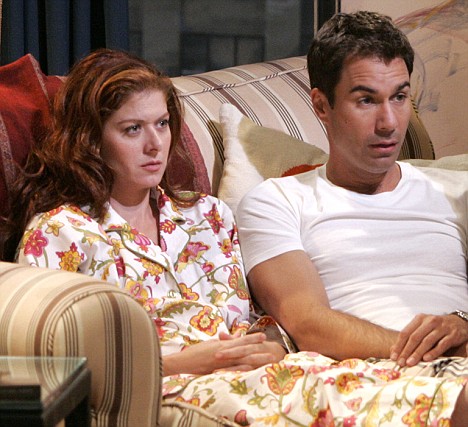
Grace (of "Will & Grace") is the modern Snow White, and we love her
Rapunzel is that girl that lets men walk all over her. She’s the one most likely to get back together with the jerk who dumped her. Because she spends most of the day locked away in her room/office, Rapunzel is bound to get into trouble when she’s partying away a Friday night. As she goes off to the bathroom to make-out with the bartender, her friends say “It’s no wonder her mother had to lock her in a tower!”
Snow White shares a flat with 3 gay guys. In fact, all of her friends are handsome gay guys who take her shopping and tell her she’s fabulous and that they can’t live without her. She stopped having girlfriends after her jealous best friend slept with her boyfriend. Snow often eats indiscriminately and feels bad about it later when she’s passed out on her sofa in an apple-turnover-induced food coma.
Sleeping Beautyis the girl we all hate because every guy hits on her and she’s totally oblivious. She has no idea how beautiful she is or how charming. Men stumble over themselves trying to buy her a drink. She’s nonchalant about dating because she never has to work to get asked out, but she doesn’t like to ruin a good night’s sleep by having a strange guy stay over. All her friends secretly hope she has an eating disorder…





 They Told Me to Find a Rich Husband